Image uploaded by SIS-TECH

Abnormal Situations Don’t Fail One System—They Fail the System

with Angela Summers

Next session: July 10th, 2026

Free More Info

Most process safety incidents don’t occur because a single system fails—they occur because the process, control system, alarms, operator, and protection layers fail together. The problem is not a lack of safeguards. It is that their performance as an integrated system is rarely verified under realistic conditions.

Dynamic simulation changes that. By recreating how the process evolves over time while executing real control logic, alarm configuration, operator interfaces, and protective functions, simulation exposes how disturbances actually develop—and whether the system stabilizes or escalates. 

This webinar shows how dynamic simulation can be used to evaluate abnormal situation response as a time-dependent, integrated problem. It highlights where performance breaks down: interacting control loops, alarm floods that obscure the initiating cause, delayed operator response, and protection layers that act too late or on the wrong variable.

The result is not theoretical insight—it is actionable verification. Engineers can confirm whether the operator can respond in time, whether alarms support diagnosis, and whether protective functions achieve the required safe state.

If you assume your system will respond correctly, this session will challenge that assumption.

Image uploaded by SIS-TECH

SSE+ 2.7 Demo

with Kushal Parikh

Next session: July 16th, 2026

Free More Info

This webinar introduces the new features of SIL Solver Enterprise+ V2.7!

SSE+ V2.7 supports the different roles and responsibilities of personnel supporting the safety lifecycle, allowing you to control who can view or edit system data and who can add to or modify corporate-wide metadata.

SSE+ V2.7 covers the documentation requirements of IEC 61511 for safety instrumented systems and the impending requirements of ISA 84.91.03 for instrumented protection layers, such as safety interlocks, BPCS, IPL, Fire and Gas, ESD, and equipment protection.  

Key capabilities of SSE+ V2.7 include scope and hazard registries, document registry, Functional Safety Assessment (FSA), audits, process requirements specification, SIL verification, Safety Requirements Specification, Application Program Specification, and I/O lists.

Image uploaded by SIS-TECH

Safety instrumented systems (SIS) are used to reduce the frequency of hazardous events in the process industry. When SIS equipment has a detected failure or requires online maintenance, the processing facility must decide whether to continue operation or shut down. Continued operation can pose risks beyond what was deemed acceptable as per the company's risk criteria. Understanding the peak risk is important to ensure that all stakeholders are aware of the risk and have compensating measures that ensure continued safe operation until the SIS equipment is returned to service. This webinar will go over use of Peak Risk Analysis (PRA) to identify unacceptable risks and to document the compensating measures required to support continued safe operation without out-of-service SIS equipment.

Image uploaded by SIS-TECH

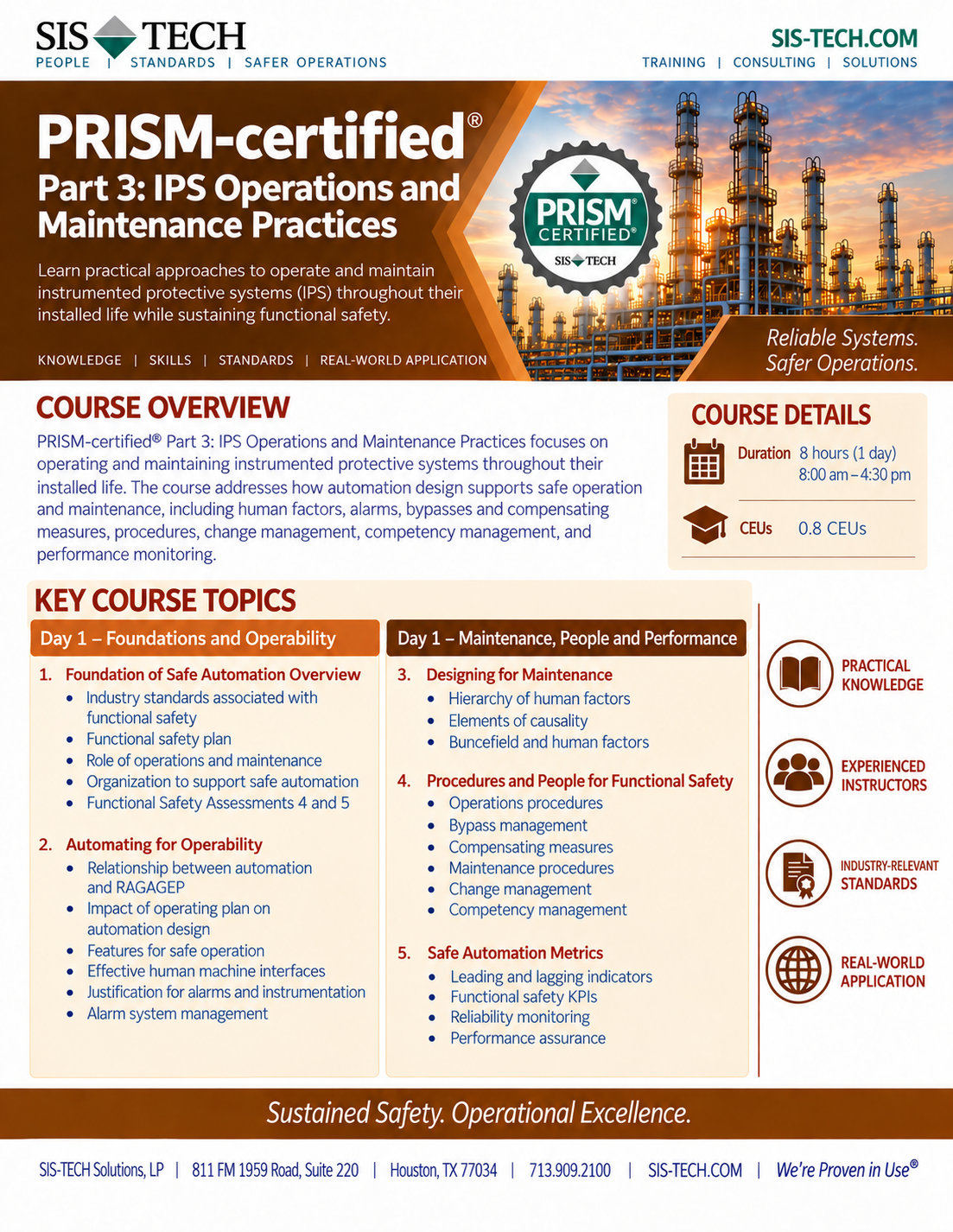
The Big Picture — Functional Safety Planning

with Eloise Roche

Next session: July 28th, 2026

Free More Info

Overview

Functional safety planning is more than a compliance exercise—it is the blueprint for protecting people, assets, and operations throughout the lifecycle of an instrumented protective system (IPS).  A well-crafted functional safety plan lays the groundwork for effective risk management, clear accountability, and successful execution of IPS projects.

In this session, Eloise Roche distills 35 years of process industry experience into the three key safety planning activities that can help any facility more reliably transform high-level functional safety objectives into measurable outcomes.

Is your team ready?

Come join us!

Image uploaded by SIS-TECH

PHA Fundamentals and Facilitation

with Kedar Kottawar

Next session: August 3rd to 4th, 2026

$1500 More Info

PHA Class Overview

This course introduces the fundamentals of facilitating a Process Hazard Analysis (PHA), with a strong emphasis on HAZOP methodology, facilitation skills, and practical application in process industries. It walks participants through the key elements of a PHA study, including defining scope, organizing nodes, establishing design intent, identifying deviations, evaluating causes and consequences, and assessing risk using qualitative ranking methods. The course highlights the role of the facilitator in guiding discussions, building team consensus, managing time, setting ground rules, and addressing dysfunctional team behavior to keep the study productive and focused. The training also covers how to identify safeguards, recommendations, and how to document findings in a PHA report. This course covers the fundamentals of how to facilitate a PHA during process design and execution, on operating units, and as part of a management of change review. The course includes hands on workshops to practice and reinforce key concepts.

Image uploaded by SIS-TECH

LOPA Fundamentals and Application

with Kedar Kottawar

Next session: August 5th to 6th, 2026

$1500 More Info

LOPA Class Overview

The course covers the fundamental concepts of Layer of Protection Analysis (LOPA) process, including initiating events, consequence severity, different risk definitions, independent protection layers (IPLs), enabling conditions, conditional modifiers, how math works, and the management processes needed to validate assumptions. Includes multiple workshops to reinforce key concepts. Attendees will gain skills to determine whether safeguards meet IPL criteria, apply appropriate risk reduction factors, and establish risk tolerance criteria aligned with industry standards.

Image uploaded by SIS-TECH

TÜV Rheinland Functional Safety Engineer Certification

with Eloise Roche

Next session: September 14th to 18th, 2026

$3400 More Info

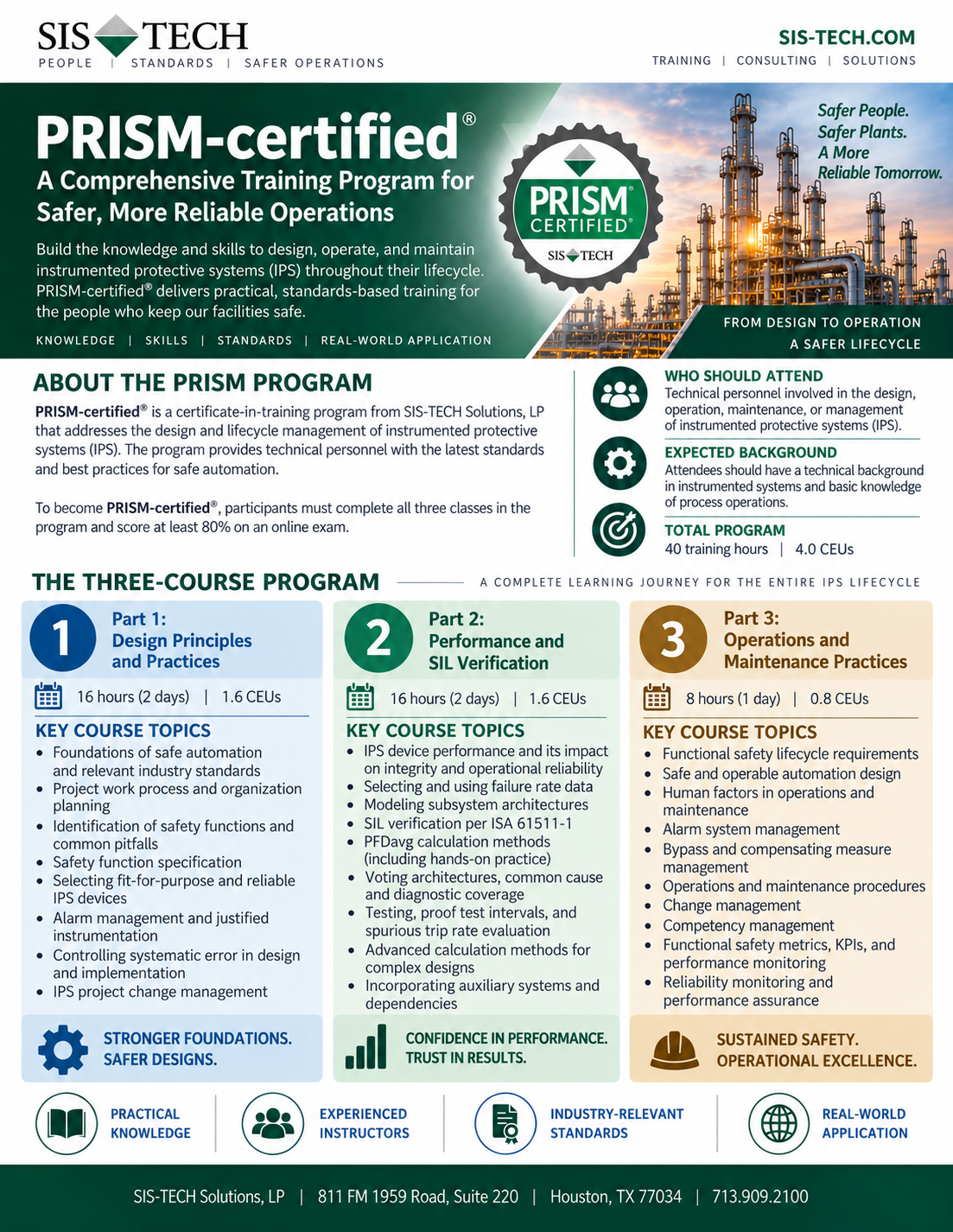
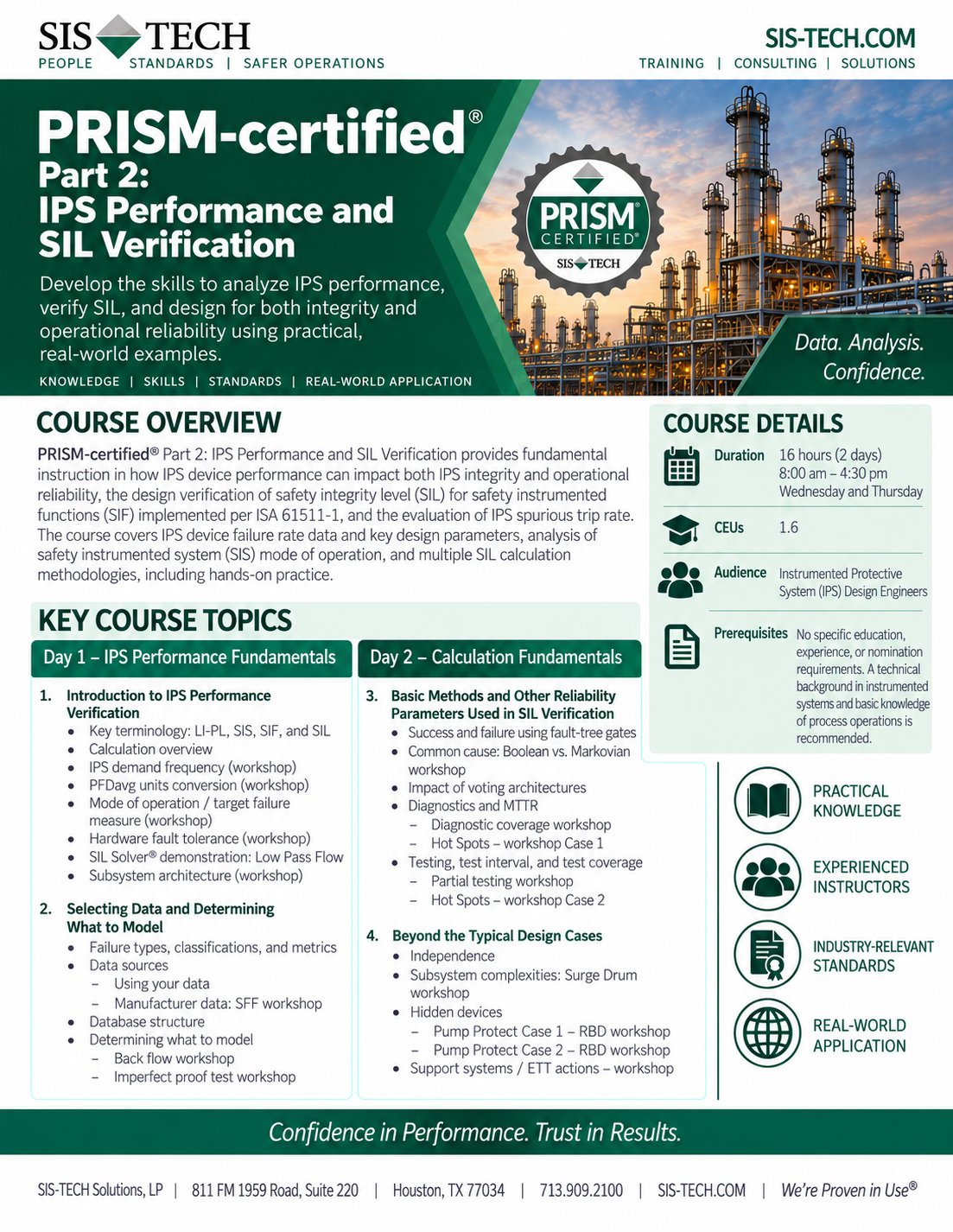
This 4-day TÜV Functional Safety Engineer preparation course delivers a comprehensive, hands-on refresher on the ISA/IEC 61511 standard, equipping participants with the breadth of knowledge required for exam success.

The course goes beyond narrow expertise to provide a holistic understanding of the safety lifecycle—from hazard identification and safety requirements specification to design, implementation, operation, and maintenance of Safety Instrumented Systems (SIS). Participants will review essential terminology, functional safety planning, and updated risk assessment approaches such as LOPA and event tree methods.

Core topics include pragmatic development of the SRS, device approval pathways, design constraints for achieving SIL targets, and mandatory assurance activities across the lifecycle. The course also emphasizes real-world practices for sustaining SIS performance in operations, including managing bypasses, compensating measures, and change management. Supplemented by engaging exercises, attendees will practice critical skills such as allocating safety functions, applying SIL verification techniques, calculating PFDavg with Boolean and Markov methods, and managing lifecycle integrity.

By combining rigorous technical content with interactive application, this course provides an engaging and practical path to mastering functional safety and preparing with confidence for the TÜV certification exam.

The detailed course outline can be found here.  4_5 day TUV

If you are renewing certification, renewal fees for TÜV Functional Safety certifications are processed separately from the standard $3,400 course tuition.  To ensure proper renewal handling, please contact Angie Fierros 713-909-2137 prior to registration.


Image uploaded by SIS-TECH

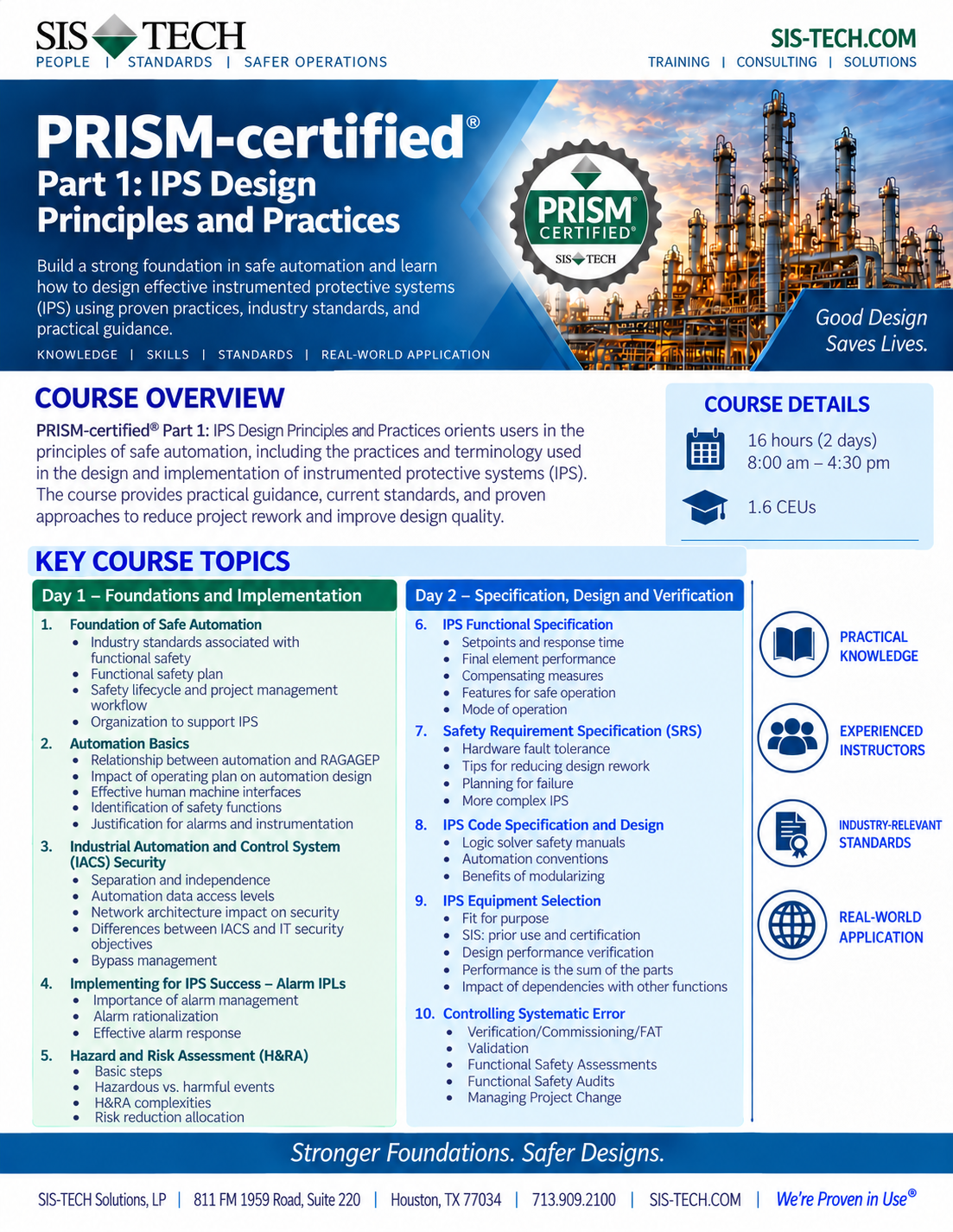
Safe Automation (16 hr Virtual)

with Eloise Roche

Next session: October 5th to 8th, 2026

$1500 More Info

Safe Automation Overview - 16 hr Virtual

Safe Automation in the Process Industry is a 16-hour virtual course designed to orient users in the principles of safe automation, including the practices and terminology used in the design and implementation of instrumented protective systems (IPS). Experienced personnel will also benefit from awareness of more recent developments in safe automation terminology, updated standards, and techniques on sharing these concepts with newer employees.

This course will introduce the key concepts and practices necessary to design and implement safe automation, including the following topics:

  • Safe Automation Lifecycle Process
  • Safe Automation Fundamentals, including Application Program, HMI, Procedure and Personnel systems
  • Instrument Justification and Alarm Management
  • Control and Safety System Hardware Selection (e.g., instrumentation, logic solvers, auxiliaries)
  • Safe Automation Metrics
  • Controlling Systematic Error in Automation Systems, including Designing for Security